POES
A fullstack enterprise operations platform with a modern TypeScript + React frontend and a robust C# backend — bridging web and enterprise systems.
What it is.
POES is a bridge between modern web architecture and enterprise backend systems. The frontend is built on TanStack Start — a minimal, server-driven framework that lets React components live on the server and stream to the client, eliminating the SPA bundle penalty.
The backend lives in C#, handling domain logic, integrations and database operations with the type safety and ecosystem maturity that enterprises expect. Together, they form a hybrid fullstack application: frontend type-safety from TypeScript, backend robustness from C#, and seamless communication between them.
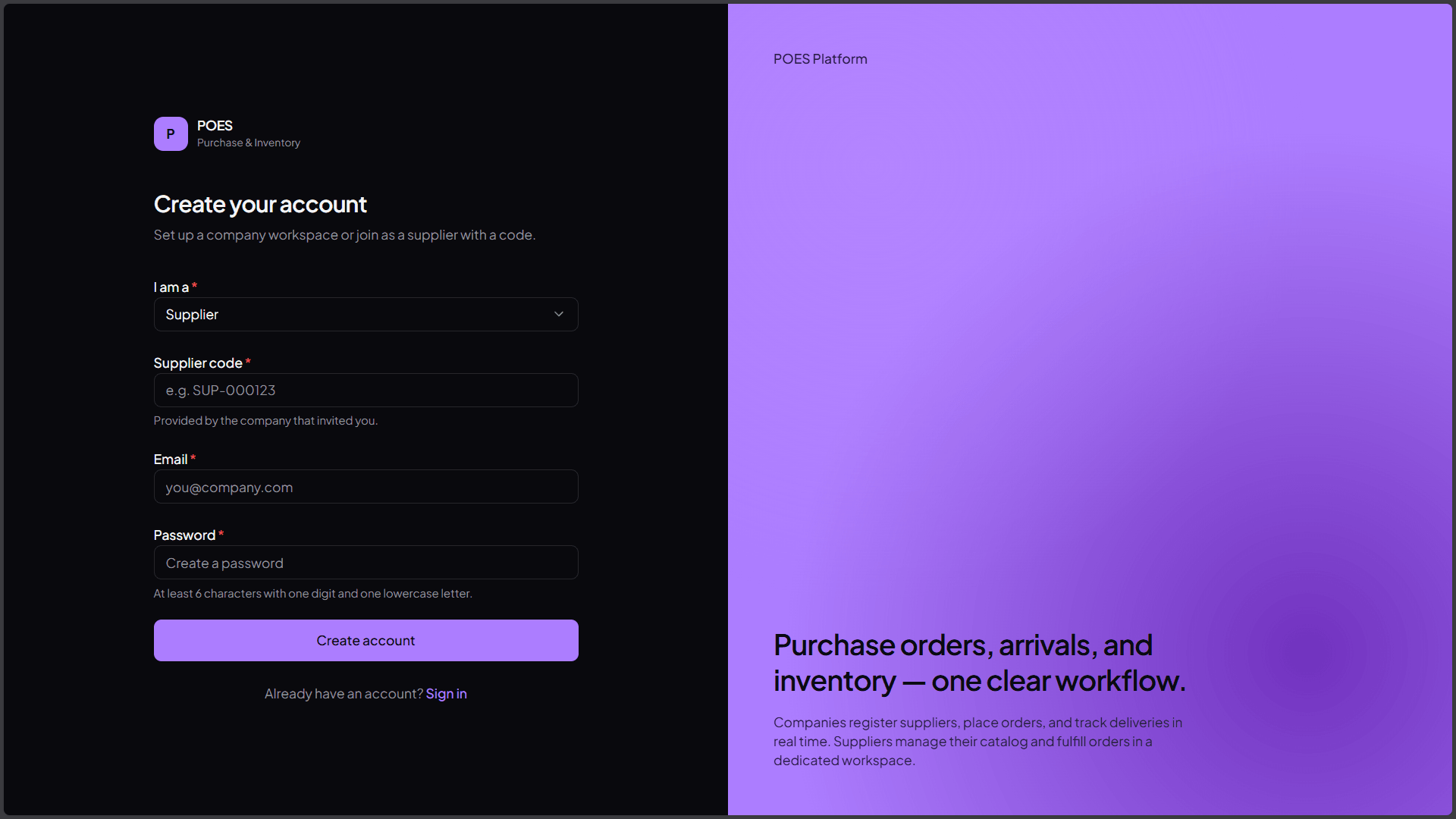
POES
TanStack Start frontend · C# backend · Enterprise-gradeProblems worth solving.
- Bridging TypeScript and C# type systems without manual sync — schema changes ripple across the full stack.
- Building a frontend that works with server-driven rendering, not a traditional REST API.
- Managing async operations across language boundaries without callback hell.
- Keeping the C# backend loosely coupled so frontend changes don't require backend rewrites.
Built in four moves.
TanStack Start for the frontend
Server components render on Node.js and stream HTML, JavaScript only ships for interactivity. No SPA, no hydration overhead.
Typed contracts
Zod validation on the TypeScript side ensures frontend and backend agree on data shapes; C# receives validated input every time.
Radix UI + Tailwind
Accessible component library with no style surprises — focus, keyboard nav and ARIA attributes baked in.
React Query for state
Server state queries are separated from UI state. Cache invalidation and background refetches handle stale data without manual toggles.
What it does.
Server-driven UI
React components render on the server; JavaScript ships only for interactivity.
Typed validation
Zod schemas validate all incoming data on both frontend and backend.
Accessible components
Radix UI primitives with full keyboard and screen reader support.
Data fetching
React Query manages async operations, caching and background sync.
C# backend
Enterprise-grade logic, database operations and integrations.
Type-safe full-stack
Changes propagate end-to-end; no runtime surprises.
How it fits together.
- TanStack Start over Next.js — less bundle, more server-side rendering, closer to traditional web architecture.
- C# backend over Node.js — enterprise ecosystem, static typing, mature libraries for business logic.
- Zod for validation — single source of truth for data shapes across the stack.
- Radix UI over headless-only — unstyled enough to be flexible, but structured enough to be accessible by default.
What it proved.
- Server-driven UI feels weird at first, but it cuts your JavaScript bundle and eliminates SPA complexity.
- Bridging type systems (TypeScript + C#) is worth the tooling overhead — schema drift becomes impossible.
- Separating server state (React Query) from UI state (local component state) makes the data flow obvious.
- Radix UI's accessible primitives are worth the extra kb — they save you from building accessible components from scratch.